Wright Unlimited

Research · Writing · Analysis

Research support you can defend.

Academic Sage Solutions works alongside MPhil, PhD and undergraduate researchers in public and private universities, nursing and teacher training colleges across Ghana — strengthening study design, running defensible analysis and preparing theses, proposals and manuscripts that satisfy supervisors, panels and journals.

Confidential by default · written quotes before any work begins

“An examiner does not read your statistics first. They read your sentence — and decide, in that moment, whether to trust the rest.”

The standard we edit to, on every project

The practice

About Academic Sage Solutions

Academic Sage Solutions is a research consultancy working with postgraduate and undergraduate researchers across Ghana — public and private universities, nursing and teacher training colleges, including UCC, KNUST, UMAT and the University of Ghana, with remote support nationwide. We work alongside the supervision you already have: strengthening the design, running the analysis and editing the writing until it holds up to the questions a panel will actually ask.

Three consultants, one Chief Editor, and a rule we do not bend — every quote is written before work starts, every draft stays confidential, and nothing is submitted in your name.

  • All institutions servedUniversities, nursing and teacher training colleges — public and private
  • 8 service linesFrom proposal development to defence preparation
  • 2 business daysTo a written response on any enquiry
  • 100% quoted up frontThe quote is the price — no add-ons later

Services

Our services

Statistical analysis, research design and academic editing. Every engagement is led by a named consultant with subject-specific expertise, with a documented method, a clear timeline and work you can defend in a supervision meeting or a viva.

Statistical & Quantitative Analysis

From instrument design to the final table: data collection, cleaning and analysis delivered with the output, interpretation and code your supervisor will ask for.

Full scope & tools
  • Data collection tools & questionnaire design
  • Descriptive & inferential statistics; hypothesis testing
  • Regression, ANOVA, multilevel & survival models
  • SEM / PLS-SEM and scale validation
  • Output in SPSS, Stata, R, Python & Excel
Research Design & Qualitative Frameworks

Sound design before data collection: a focused problem statement, achievable objectives and a theoretical framework that carries through to your discussion.

Full scope & tools
  • Problem identification, gaps & research questions
  • Conceptual and theoretical frameworks
  • Qualitative, quantitative & mixed-methods designs
  • Thematic, framework & phenomenological analysis
  • Sampling strategy, ethics & data collection protocols

Thesis, Manuscript & Grant Editing

Structural editing and referencing against your department's rubric or a journal's guidelines — with originality checks built into the workflow, not bolted on.

Full scope & tools
  • MPhil / PhD theses and undergraduate projects
  • Research proposals, grant applications & SoPs
  • Literature reviews and scholarly argument
  • Referencing (APA, Harvard, MLA, Chicago) & consistency
  • Plagiarism reduction and AI-content screening

What it costs

Every project is quoted in writing before any work begins, and the quote is the price — no add-ons later. The figures below are starting points so you can tell, in a few seconds, whether we are within reach.

Data analysis

Clean dataset, standard descriptive and inferential tests, output, interpretation and code.

FromGHS 1,100

Regression, ANOVA, SEM or thematic coding quoted after we see the data.

Proposal & concept

Problem statement, objectives, questions, conceptual framework and data plan.

FromGHS 1,500

Includes one round of supervisor-comment revisions.

Chapter editing

Language, structure, referencing and coherence, edited to your department's guide.

FromGHS 650 / chapter

APA, Harvard, MLA, Chicago or the departmental style in use.

Full thesis support

Design to defence, chapter by chapter, with the originality and AI screen throughout.

FromGHS 5,800 / MPhil thesis

MPhil, 120 pages. A doctoral thesis runs to 250 pages and quotes from GHS 12,500. Instalments by chapter.

Free plagiarism check with every project · MoMo and bank transfer accepted · instalments by chapter. Deadlines under seven days carry a rush premium, always quoted before you commit.

Ask for a quote

Client feedback

What researchers say

Names are withheld by default — the point is the experience, not the client list. Every quote below is given with permission and edited only for length.

“I came in with data and no idea what to do with it. What I left with was a defensible method, the syntax to reproduce every table, and the language to explain it to my panel.”

MPhil candidatePublic health · KNUST

“My supervisor's comments had stopped making sense to me. They worked through them one by one, in the margin, and flagged the two where I needed to push back rather than guess.”

PhD candidateEducation · University of Cape Coast

“The written quote came before anything started, and the final invoice matched it. That alone told me the practice was run properly.”

Undergraduate researcherAgricultural science · UMAT

Want to speak to someone who has used the service? Ask us for a reference and we will put you in touch with a past client who has agreed to be contacted.

Sample edit

Before and after a methodology review

This is a real pattern, not a promise. The left column is a methodology paragraph as it is usually submitted. The right column is the same study after a methodology review — same data, same researcher, defensible design.

Open the before-and-after comparison

Methodology extract · margin notes · what changed and why
As submitted

Chapter three of this research talks about the methodology that was used in gathering the data for the study. The researcher used questionnaire to collect data from respondents in the study area. A sample size of 400 respondents was selected using the simple random sampling technique because it is the best method. Data was analysed using descriptive statistics and also inferential statistics were used. The researcher also ensured that the instruments were valid and reliable before going to the field.

  • Design never named. “Methodology” is a chapter, not a design — cross-sectional? experimental? case study?
  • Sample size asserted, not derived. Where does 400 come from?
  • “Because it is the best method” invites the obvious follow-up question.
  • No instrument, no period, no place — three details the panel will ask for.
  • “Valid and reliable” claimed without saying how either was established.
After review & edit

This study employed a cross-sectional survey design. Data were collected with a structured, self-administered questionnaire across four communities in the Cape Coast Metropolis between March and May 2026. Following Krejcie and Morgan's (1970) table, a target sample of 384 was drawn from an estimated population of 9,400 women of reproductive age; 412 valid responses were returned, a response rate of 94%.

Households were selected by systematic random sampling from the 2022 enumeration area list, after which one eligible woman per household was chosen at random. Analysis proceeded in two stages: descriptive statistics described the sample, and binary logistic regression tested the four hypotheses at p < 0.05.

  • Design named in the first sentence, so the reader knows what to expect.
  • Sample justified against a cited table and a stated population.
  • Response rate disclosed, so no one has to ask.
  • Each hypothesis tied to a test, which is what “analysis” has to mean.
  • Consistent past tense and voice throughout, with no first-person drift.

The full three-page diagnostic, free. The reviewed paragraph, the six margin notes, a before-and-after comparison table and the ten-point checklist we work to — as a PDF you can print or send to your supervisor.

Client details changed and the extract shortened · 3 pages · no email required

Download the diagnostic (PDF)

Our approach

How we work

We work as an extension of your supervision team. Each stage ends with a deliverable you can take straight into a supervision meeting, so you always know what was done, why, and what it means for your submission.

  1. Consultation & scoping

    A 45-minute methodology review and a written diagnostic of your topic, objectives, design and the specific risk of examiner objection.

  2. Proposal & design

    Problem statement, objectives, conceptual framework and data plan agreed — with the instrument and sampling strategy signed off before fieldwork.

  3. Analysis & drafting

    Data collected or received, cleaned and analysed, with output, interpretation and code handed over as you go.

  4. Review & handover

    Full edit for argument and referencing, an originality report and AI-content screen, and a mock defence session before submission.

Originality & academic integrity We coach, review and edit — the argument, analysis and final submission remain yours. Every project passes through an originality report, and we will decline work that asks us to submit as you. Your data and drafts are treated as confidential and never reused.

Book your review

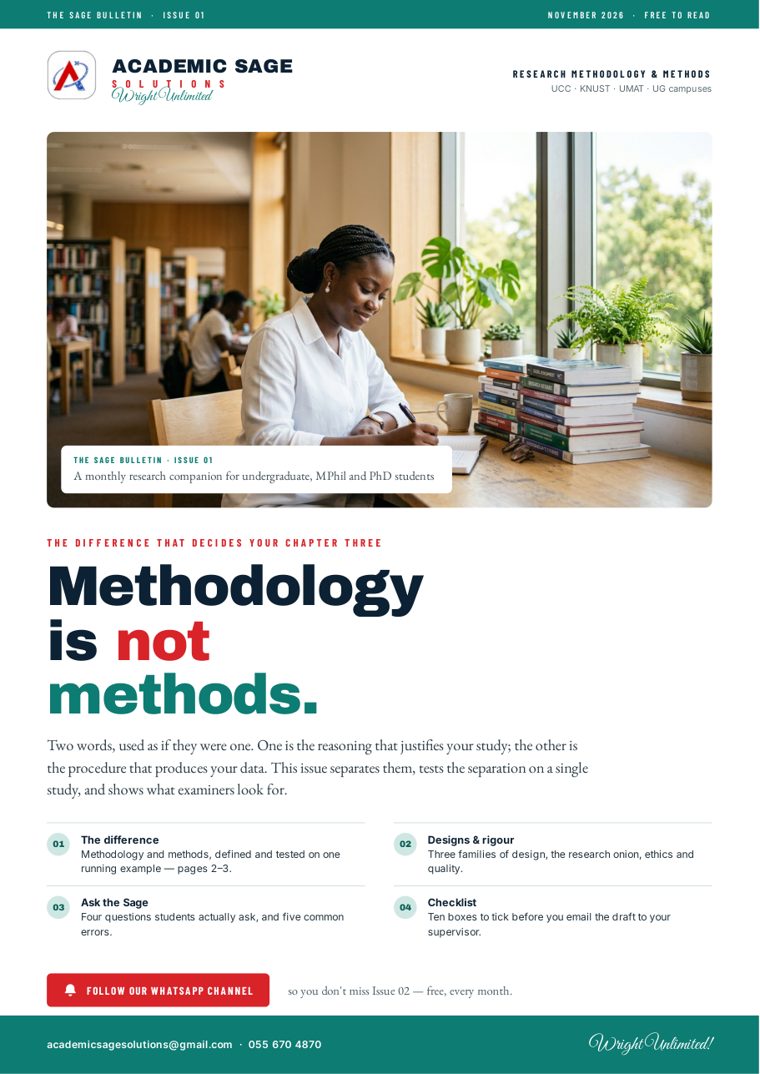
The Sage Bulletin

The Sage Bulletin

Issue 01 is out now — November 2026. Every month our consultants send one practical research tip, one tool worth using, the deadlines that matter for the coming weeks, and an answer to a question students actually ask. This issue: Methodology is not methods — the distinction that decides your Chapter Three.

  • Research tip of the month
  • Tool spotlight
  • Deadline radar
  • Ask the Sage — reader questions answered

Free · monthly · visit the bulletin →

Free tools

Free tools & downloads

Five tools in one panel — switch between them with the buttons below: Cost estimate, Which analysis?, Reference formatter, Chapter tracker and Downloads. Everything runs in your browser; nothing is sent to us unless you ask for a quote.

80 pagesdrag to adjust

MPhil theses usually run 90–130 pages. Doctoral theses are capped at 250 pages; anything longer is quoted individually.

Indicative rangeGHS 3,800 – 4,900

Typical delivery 4–6 weeks · originality check included

This is an estimate, not a quote. The figure is fixed only after we have seen your material — scope, data state and the standard your department expects all move it. Nothing is charged before you accept a written quote.

From the Chief Editor

Every deliverable is edited before delivery

Portrait of Rev. Isaac Nyanful, Chief Editor at Academic Sage Solutions

Rev. Isaac Nyanful

Chief Editor

PhD Candidate · Linguistics & Political Theology

Academic editing, proofreading,
language and coherence of argument

However strong the analysis, the examiner meets the sentence first.

My work begins where the statistics end. A panel reads for meaning before it reads for method, so I look for three things in everything the practice produces: that the language says exactly what the researcher means, that the argument is stated once and then carried through every chapter without drift, and that sources are cited in a form the department will accept without comment.

I review theses, proposals, manuscripts and term papers at the final stage — language and style, coherence of argument, referencing, and the small errors of grammar and formatting that quietly cost marks. Clear writing is not decoration. It is the difference between work that is understood and work that is merely submitted.

Rev. Isaac Nyanful Chief Editor · Academic Sage Solutions

Contact

Schedule a methodology review

Tell us where your project stands. A consultant will reply within two business days with an honest read on feasibility, an indicative scope and a proposed meeting time.

Your draft, data and correspondence stay confidential. Read our confidentiality & academic-ethics policy.

Prefer to talk it through?

Book a free 30-minute methodology review straight into the calendar — pick a slot and we send a Google Meet link. You leave with an honest read on feasibility, whether or not you go on to work with us.

Open the booking calendar Prefer WhatsApp? Ask for a slot Or email for a slot Message us on Facebook Messenger
30 minutesFreeGoogle MeetMon–Sat

Project intake form

Fields marked are required.

Please enter your full name.

Please enter a valid email address.

Please tell us where you are based.

Please give a number we can reach you on.

How you would like us to reply.

Please select a discipline.

Optional — helps us route your enquiry.
Optional — helps us judge feasibility.
Topic, level of study, data status and the specific support you need. 40–1,500 characters.

0 / 1500

Please describe your project in at least 40 characters.

Response within two business days.
No obligation, no charge for the review.

Frequently asked

Frequently asked questions

How quickly can you take on a project?

Most engagements begin within three to five working days of the methodology review. Data analysis on a clean dataset typically takes one to two weeks; full thesis support runs across the semester. Deadline work is possible and is quoted separately.

Do you write the work for me?

No — and we will say so plainly. We design, analyse, coach and edit; the scholarship and the submission remain yours. What you get is a documented method, interpretation you understand, and text edited to the standard your examiners expect. Every project passes through an originality check before it leaves us.

How much does it cost?

Data analysis starts from GHS 1,100, a research proposal from GHS 1,500, chapter editing from GHS 650 per chapter, full MPhil support from GHS 5,800 for a 120-page thesis, and full doctoral support from GHS 12,500 at the 250-page ceiling — see what it costs for the detail. Every project is quoted in writing before work begins, the quote is the price, and instalments by chapter are accepted. The originality check is free on every project, and a rush deadline under seven days carries a premium we tell you about before you commit.

What is The Sage Bulletin, and what does it cost?

The Sage Bulletin is our free monthly note for researchers: one research tip, one tool worth using, the deadlines and funding calls closing in the coming weeks, and an answer to a question students actually ask. Issue 01 goes out in November 2026. You can ask to be added through the intake form — choose “The Sage Bulletin” as the service — and you can leave the list at any time. It is not a sales sequence, and we never pass your address to anyone else.

How long can a thesis be, and how does length change the price?

An MPhil thesis in most Ghanaian departments runs 90–130 pages, and we quote GHS 5,800 for full support on a 120-page MPhil thesis. Doctoral work is capped at 250 pages in most regulations; full support at that ceiling is GHS 12,500. Length is charged at a per-page rate, so a shorter piece of work costs less — put your own page count into the cost estimate and the range updates as you drag.

Do you have tools I can use before contacting you?

Yes — five, free and without an email address: a cost estimate, a which-analysis picker that names the test and the software, a reference formatter for APA 7, Harvard, MLA 9 and Chicago, a chapter tracker that saves your progress in your own browser, and free PDFs including the methodology diagnostic. They all live in the tools panel on this page.

What is the free plagiarism check, and how does AI screening work?

Every project receives a similarity report at no cost, with a short explanation of what is genuinely problematic and what is simply common phrasing. AI-content screening identifies passages likely to be flagged by your institution's detector, and we support rewriting them in your own voice — the goal is prose that reads as yours, not a report that hides a problem.

Is my data and draft kept confidential?

Yes. Files are shared only with the consultant assigned to your project, never reused or shown as samples without written permission, and deleted or returned on request at the end of the engagement. Where your ethics approval restricts data handling, tell us at the review stage and we will work within it.

Can you work with a supervisor's comments?

That is most of what we do. Send the comments, rubric or examiner report and we will work through them point by point, respond in the margin where useful, and flag any comment that conflicts with your design so you can raise it in supervision rather than guess.

Start with a methodology review.

One conversation is usually enough to see where the methodological risk sits.